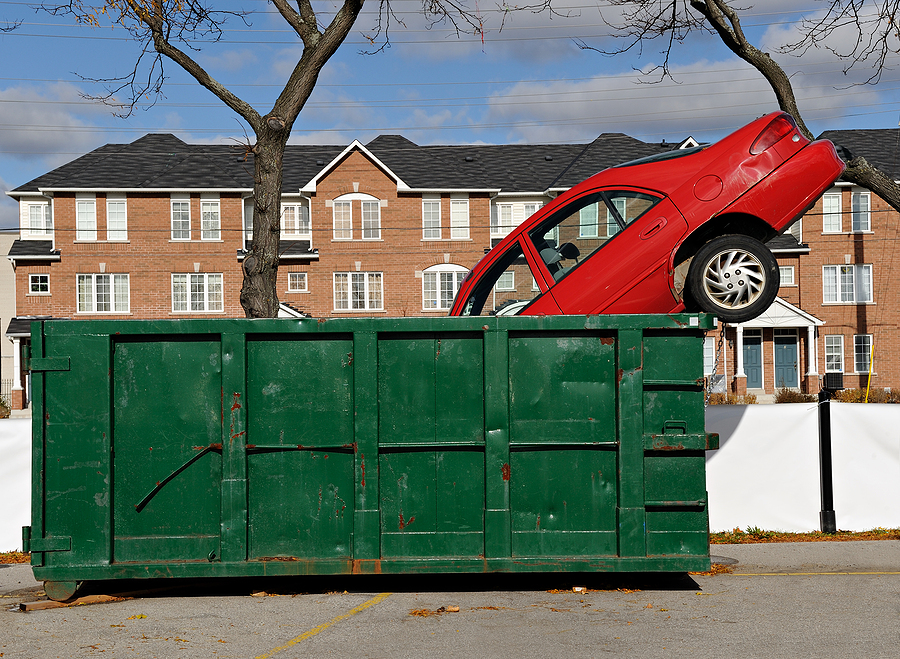

Your mechanic calls with the estimate, and it's a big one — a transmission, a blown head gasket, rust through the frame, a failed safety with a page of line items. The car still gets you to work, but it's old, and that number is more than you'd like to spend. Do you fix it or scrap it? It's one of the most common questions Ontario drivers face, and the good news is there's a straightforward way to answer it. This 2026 guide walks through the simple math, what common repairs actually cost, and the point where scrapping your car for cash is clearly the smarter move.
The 50% rule: the fastest way to decide
Mechanics and consumer advocates have long used a simple test: if a repair costs more than half of what the car is currently worth, it's usually not worth doing. A $2,500 transmission in a car worth $8,000 is an easy fix. That same $2,500 transmission in a car worth $3,500 is money poured into a vehicle that will keep needing more. The 50% rule isn't a hard law — it's a sanity check — but it cuts through the emotion fast. The first step, then, is knowing your car's real market value, not what you feel it's worth or what you paid for it years ago.
How to find your car’s real value before you decide
Look up your exact year, make, model, trim and mileage on a couple of Canadian valuation sources and private-sale listings for the same vehicle in Ontario. Be honest about condition — a car with rust, high mileage and a pending repair is at the bottom of its range, not the top. Now weigh the repair estimate against that number. If the car's realistic private-sale value is $2,800 and the repair is $1,800, you're spending 64% of the car's worth to keep a vehicle that will likely need the next repair within a year. That's the moment to price out the scrap option.
What common repairs actually cost in 2026
Repair bills are what tip most older cars over the edge. In Ontario in 2026, ballpark figures run roughly: a replacement transmission $2,000–$5,000; a head gasket or major engine repair $1,500–$4,000+; a full exhaust and catalytic converter $1,200–$3,000; significant rust or frame repair $1,000–$3,000+ (and often not worth doing at all on a unibody car); a failed-safety list — ball joints, brake lines, tie rods, bearings — commonly $1,500–$3,500 stacked together. When a single repair, or a safety list, approaches or exceeds the car's value, the 50% rule has already answered your question.
The hidden costs of keeping an old car on the road
The repair estimate isn't the whole picture. An aging car tends to fail in sequence — fix the transmission and the suspension is next, then the rust, then the next safety. You're also paying to insure and licence a vehicle that's losing value every month, and in Ontario every winter of road salt accelerates the rust that eventually makes a car unsafe to certify at any reasonable cost. Factor in the tow bills, the rental while it's in the shop, and the stress of an unreliable car, and 'just fixing it one more time' is often the most expensive choice of all.
When scrapping for cash is the smarter move
Scrapping makes sense when: the repair exceeds ~50% of the car's value; the car has failed a safety and the repair list is long; there's serious structural rust; the vehicle is already worth under about $3,000 and needs major work; or you simply can't rely on it anymore. In those cases, instead of spending thousands to prop up a declining asset, you convert it to cash today. In Ontario in 2026, a scrap car pays $200–$900 for standard vehicles, with trucks, SUVs, hybrids and newer write-offs paying more — up to $20,000 for the right vehicle. You also stop paying to insure and store a car you don't trust.
Repair vs scrap: a worked example
Say you own a 14-year-old sedan with 230,000 km. A private sale in good order might fetch $3,000, but it just failed safety with $2,600 of work needed, and it has visible rust. Fixing it costs 87% of its best-case value — to own a high-mileage car that's still rusting and will need more soon. Scrapping it instead puts cash in your pocket the same day, ends the insurance and the worry, and lets you put that $2,600 you would have spent toward something reliable. The math isn't close. The 50% rule flagged it the moment the estimate came in.
Get a scrap quote before you authorize the repair
Before you say yes to an expensive repair on an older car, it costs nothing to find out what the vehicle is worth as-is. Call ScrapCash GTA at (647) 983-9577 or request a 60-second online quote with your year, make, model and condition. We're a licensed, ELV-certified Ontario recycler: we quote honestly, buy running and non-running cars alike, tow free the same day across the GTA, handle all the paperwork, and pay top-dollar cash on the spot. Knowing the scrap number turns a stressful repair decision into a simple one.
Ready to find out what your car is worth?
Call us with the year, make, model and condition — we'll lock in your top-dollar 2026 quote in 60 seconds, with free same-day pickup anywhere in the GTA.
We’re a family-run, Ontario-licensed auto recycler that has bought and recycled 15,000+ vehicles across the GTA since 2010. Our guides are based on real, day-to-day experience buying scrap and junk cars, handling ServiceOntario paperwork, and paying fair, transparent prices.